

Boardroom Insights 2026 - for Board Members
What is top of mind for Swiss Board Leaders
Geopolitical tensions, volatile financial markets, and artificial intelligence as a disruptor – companies are facing complex challenges that are all unfolding at the same time. For boards of directors, this means a reset of the agenda. The central question is increasingly how decision-making processes can be aligned on a data-driven basis and under real-time conditions. Boards’ own capability gaps are also moving into focus.
Challenge 1 – “Skin in the Game” leadership beyond collective cover
Against the backdrop of an uncertain global economic environment, fundamental questions are becoming more central in the boardroom: business models, portfolio logic, and long-term positioning are being reassessed.
Seventy-four percent of the board members surveyed by Knight Gianella rate strategic discussions in 2025 as “highly relevant” – nearly twice as many as in 2023. At the same time, a tension is emerging between long-term strategic continuity and the need for short-term adjustments under changing conditions.
This increases the demands on boardroom leadership. Boards are increasingly expected to assume visible responsibility. Board members can and should no longer “hide” behind the collective body. Leadership with “skin in the game” (the leader shares responsibility and bears the consequences of their decisions), as well as trust in management, are key prerequisites.
This also shifts the role of the chair. What is required is not only strategic foresight and strong business judgment, but above all the ability to moderate complex decision-making processes within the board in a structured, balanced, yet critical way. This means moving beyond a purely knowledge-based perspective and actively soliciting views. It also requires flexibility in the meeting agenda, where a trend toward more frequent but shorter meetings is emerging.
This also makes sense in the context of geopolitical developments. Since Russia’s attack on Ukraine, an economic environment has emerged that is shaped by wars, trade barriers, and the politicization of economic relations.
The international order is moving toward a bipolar structure, with the United States and China as the central poles of power. At the same time, economic perceptions are shifting: China is increasingly viewed as an innovation market, while the United States continues to play a central role as a sales and investment market. For management, this creates a high level of complexity in the strategic navigation of global markets. Eighty-five percent of the surveyed board members and CEOs consider the geopolitical situation to be “highly” or “fairly” relevant to their agenda – a significant increase compared with 2023.
In this global environment, strategy becomes a discipline of continuous adaptation under real-time conditions. This requires faster decision-making processes, greater organizational resilience, and the deliberate integration of geopolitical expertise into the leadership work of boards of directors.
Challenge 2 – Data as a strategic lever for decision-making processes and artificial intelligence as a key success factor
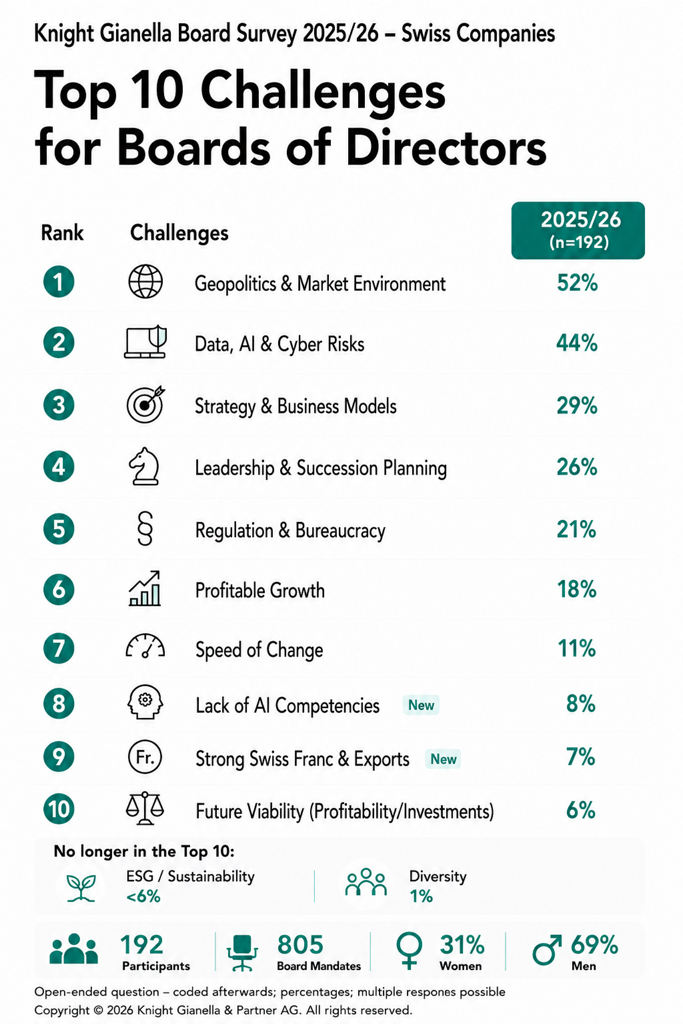
Artificial intelligence (AI) is one of the three key topics at board level and is considered highly strategically relevant. In the current survey, it therefore ranks second among the most important challenges for boards of directors.
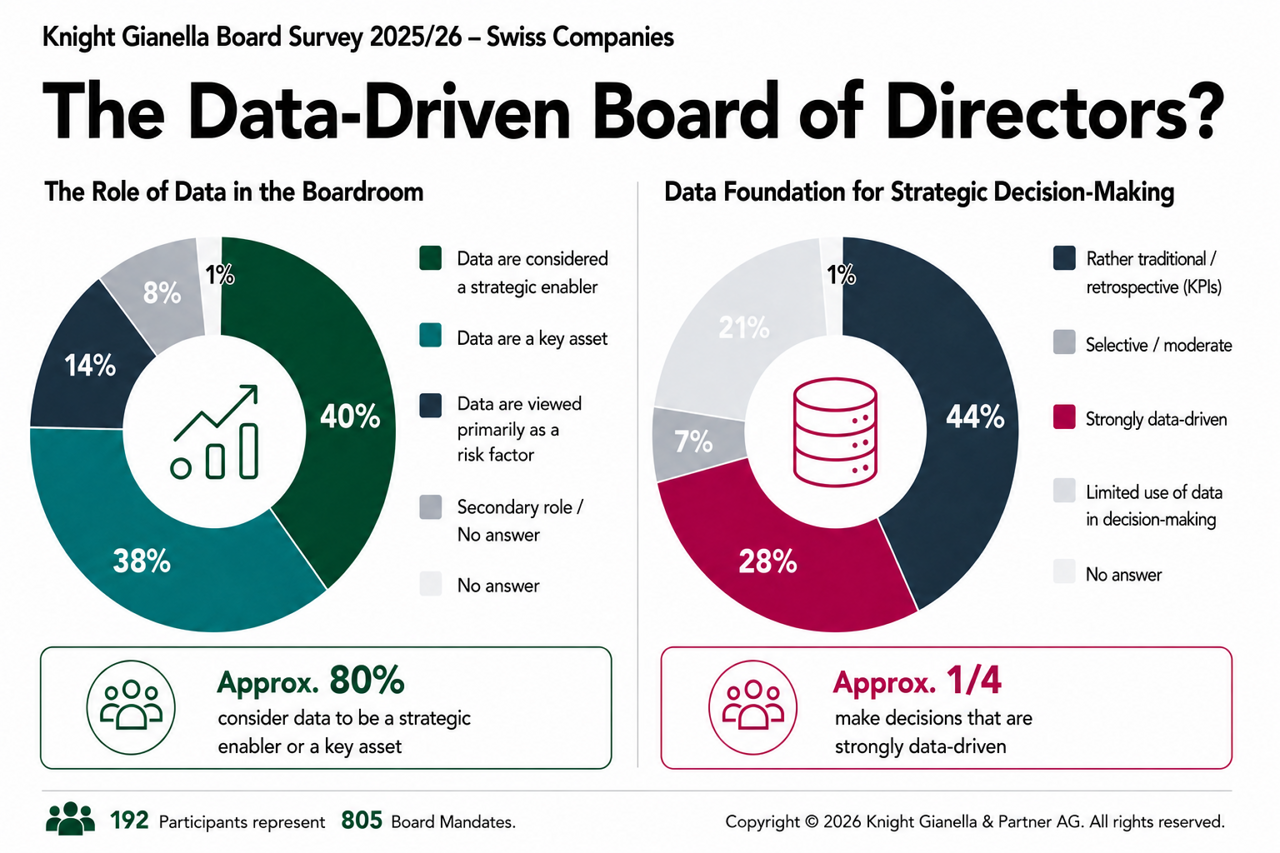
At the same time, there is a clear gap between strategic relevance and operational anchoring. While AI is generally viewed as critical to competitiveness and the scaling of business models, only just over a quarter of boards currently use data-driven decision-making processes systematically at board level. A substantial share of boards still primarily works with retrospective KPIs. At the same time, however, nearly 80 percent of respondents see data as a strategic asset.
For the first time in the ten-year history of Knight Gianella’s board survey, boards are also taking a self-critical look at their own level of expertise – reflected in this topic moving into the top ten current challenges. Only a small minority is satisfied with its own level of AI expertise, while a significant share has so far implemented hardly any structured measures.
The new technology presents boards with fundamental challenges. With an average age of around 58, long-established decision-making logic with a primarily backward-looking perspective is meeting a rapidly evolving technology that requires significant investment and still involves many unknowns. The board’s capability portfolio – and therefore its skills matrix – is being challenged.
Given this starting point, boardroom leadership must necessarily include the active development of the board’s own knowledge. However, our data shows that continuing education in boards of directors is often not systematically embedded and that institutional frameworks – such as fixed budgets – are missing in many cases. Too often, further training is left to board members on a voluntary basis. This must change.
Challenge 3 – ESG and diversity between headwinds and necessity
ESG and diversity are currently among the most polarizing topics in boards of directors. While more than 50 percent of respondents continue to rate environmental and social topics as relevant to highly relevant, the share of those who consider ESG to be of little or no relevance has risen significantly – from 21 percent in 2023 to 44 percent in the current survey.
This shift is particularly visible in the different prioritization between male and female board members, with men representing the majority in the sample.
A similar development can be seen in gender diversity. While the topic was strongly and publicly driven in recent years, a certain fatigue or shift in priorities is currently becoming apparent, reinforced by the political discourse in the United States and the perception that target levels have already been reached.
At the same time, the strategic relevance of ESG and gender diversity remains in place over the long term. Sustainability aspects are central in the context of generational change and employer attractiveness, while diversity of perspectives in leadership bodies continues to be a relevant factor for the quality of decision-making as well as for innovation.
Three leadership recommendations for board members:
Recommendation 1: “Skin in the game” leadership focuses on transparency, speed, and adaptability. The board of directors must assess whether it is set up accordingly and adjust the agenda where necessary.
Recommendation 2: Data is the new gold of the future. Strategic boards are required to build this asset in a structured and targeted way in order to make data-driven decisions going forward. They must also close knowledge gaps in artificial intelligence.
Recommendation 3: Future-oriented topics such as ESG and diversity should be maintained despite current headwinds and signs of fatigue. Their strategic relevance is undisputed.