

Boardroom Insights 2026 - for CEOs
Expectations of CEOs became even more pronounced in 2025: what is required is a deep strategic understanding of technology, strong decision-making ability, and the capacity to systematically integrate an increasingly volatile market environment into entrepreneurial decisions. For CEOs, this means steering their organizations with more agility and focus than ever before.
Challenge 1 – Steering technological complexity strategically and ensuring knowledge transfer from the CEO to the board of directors
Digital transformation has been one of the priority topics at CEO level for years and remains one of the key challenges in 2025. With the breakthrough of artificial intelligence (AI), this field of action has gained even greater strategic importance.
The momentum around AI is characterized by high speed and, at the same time, significant uncertainty. Investment decisions are correspondingly demanding. Investments in AI are, in many respects, strategic upfront investments – a forward-looking strategic investment.
A 2025 study of 400 industrial companies in 34 countries[1] shows that Switzerland is still at an early stage: only 7 percent of the companies surveyed have already fully integrated AI into their processes, while 40 percent expect AI to have a significant impact on their business models by 2030.
Boards of directors today expect CEOs to have a sound understanding of the strategic competitive advantage created by new technologies, as well as the ability to steer complex digital transformations in a targeted way. They must also be able to protect their digital infrastructure. In PwC’s CEO Survey 2026, 52 percent of CEOs in Switzerland ranked investments in cybersecurity as their top response to geopolitical risks. This is higher than the global average. “Swiss CEOs take cybersecurity very seriously,” the study states.
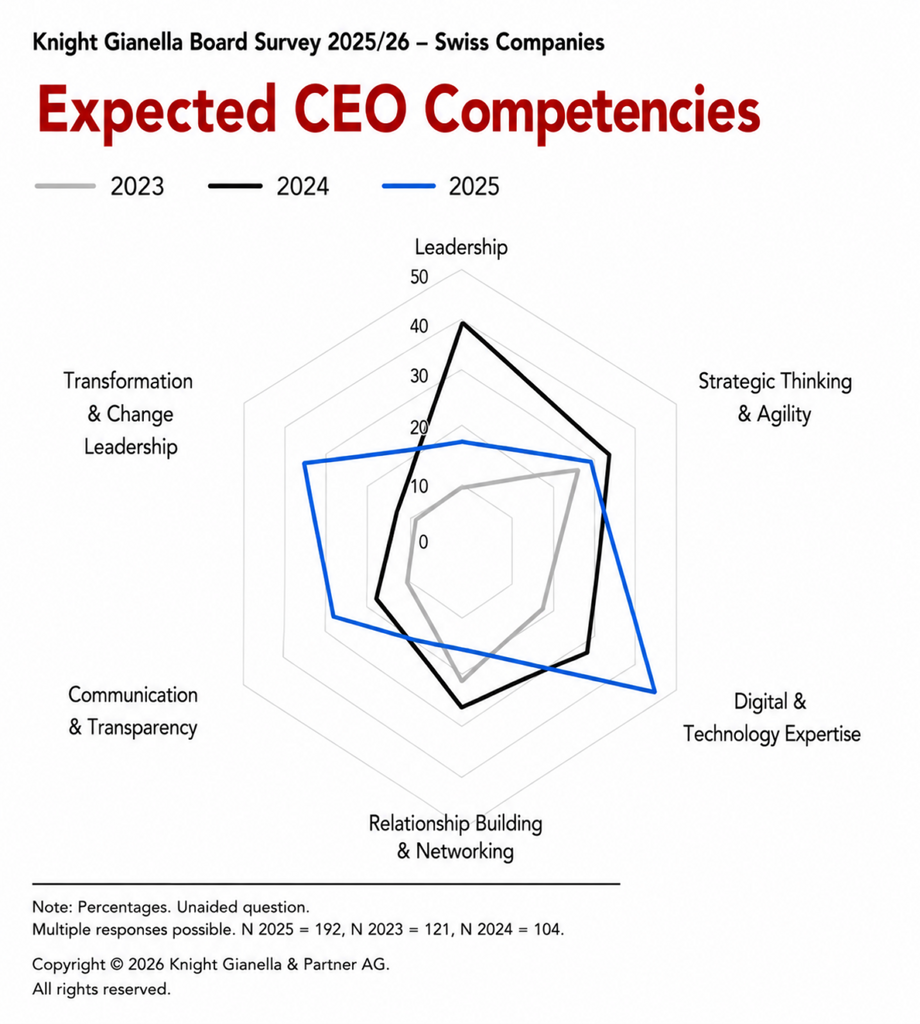
Approximately 90 percent of the board members surveyed by Knight Gianella are convinced that the requirements placed on CEOs’ technological and AI-related expertise will continue to increase over the next two years. Only a minority believes that the current level of expertise is sufficient. At the same time, with a topic as new as AI, the board of directors cannot draw on past experience either. Differentiated expectation management toward the board therefore becomes a key competence for successful CEOs. They take on a dual role: on the one hand, they must close their own capability gaps in technology; on the other, they must ensure structured knowledge transfer from management to the board of directors.
Challenge 2 – Decision-making strength and transparent communication to secure acceptance and implementation of the AI transformation
For years, the increasing speed of change has presented CEOs with growing challenges. Global competition in the field of artificial intelligence is further intensifying the constant pressure to transform and innovate. What is needed are leaders with clear strategic shaping power and the ability to act decisively even under uncertainty. An overly consensus-oriented leadership style is increasingly reaching its limits in an environment of recurring market disruptions – not least reflected in rising turnover at the top of companies.
The multitude of external factors acting at the same time forces CEOs to prioritize their agenda consistently. Clear focus thus becomes a decisive success factor in leadership.
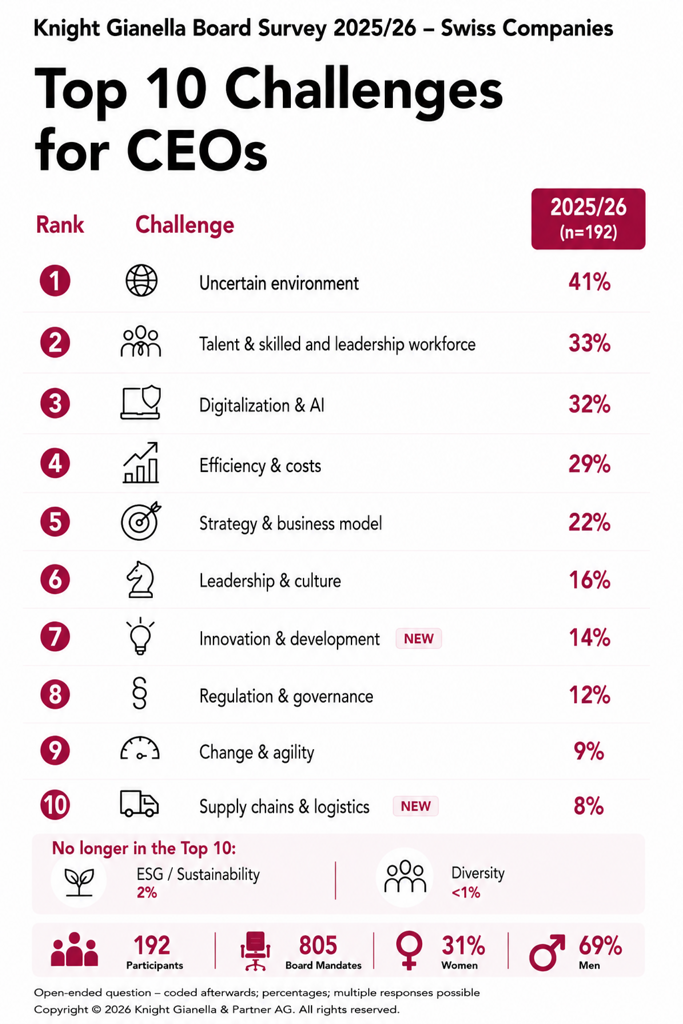
Geopolitical tensions, trade conflicts, currency issues, volatile energy prices, and fragile supply chains have a direct impact on day-to-day business. In Knight Gianella’s current survey, the geopolitical environment is named as the greatest challenge, with many CEOs rating the strong Swiss franc as particularly critical – even more critical than the tariffs imposed by the United States.
CEOs are required not only to manage these global risks, but to integrate them systematically into strategy and business model decisions. Eight out of ten Swiss business leaders have changed their strategic investment plans due to the altered geopolitical framework.[2] CEOs should align innovation and investment in a way that keeps their companies fit for the future: through focused portfolio strategy, regional value creation, and fewer critical dependencies (e.g., in the supply chain). At the same time, they must keep an eye on new technological developments for future ecosystems.
This permanent adaptation requires high pressure resistance, fast decision-making channels, and the ability to continue pursuing long-term strategic goals with discipline. This is demanding.
The high pace of change also increases the demands on communication. Organizational agility only emerges where the direction is understandable and trust in management decisions exists. In the context of AI in particular, a perception gap often becomes visible between management and employees: while management tends to assess the development more optimistically, the workforce often has reservations.[3] A growing number of employees feel unsettled by AI. One of the decisive success factors is therefore to convince the workforce of this transformation. In our current survey, approximately 72 percent of Knight Gianella respondents also assume that the requirements for communication and transparency will continue to increase in the coming years.
Challenge 3 – Building and actively managing a diverse talent pipeline is more important than ever
Nearly 70 percent of the board members surveyed by Knight Gianella expect increasing requirements in leadership, team development, and talent management over the next two years. The shortage of skilled labor remains one of the three most important challenges at CEO level.
At the same time, practice shows that the systematic development of high potentials for top positions is often not pursued with the necessary consistency – especially in phases of high operational pressure and strong pressure to deliver short-term financial gains. In many organizations, this results in so-called “leaky pipelines,” which jeopardize the sustainable development of leadership talent and ultimately create a vacuum.
In parallel, there is a stronger tendency to attract new profiles that can manage the next phase of transformation and respond to the new career expectations of the next generation of leadership talent – from work-life balance to a life first approach. There is also a tendency toward filling key positions locally.
Regardless of political cycles, the targeted promotion of diversity remains a central success factor. CEOs would be well advised to address the development of female leaders early and systematically in particular. Regulatory targets – including a 20 percent share of women at executive management level by 2031 – further underline this necessity.
The diversity of leadership bodies is a relevant factor in decision-making precisely because of the increasing complexity of business models – and not merely a nice-to-have.
Our three leadership recommendations:
Recommendation 1: Establish technology/artificial intelligence as a strategic CEO priority and prepare the relevant fields of action for the board of directors.
Recommendation 2: Focus and prioritize the CEO agenda consistently – eliminate or delegate what is unnecessary. Accelerate decision-making processes while ensuring clear, transparent communication.
Recommendation 3: Build and actively manage a sustainable talent pipeline – with several qualified candidates for executive management succession and with diversity criteria taken into account.
[1] PwC in Operations Survey 2025
[2] CEO Outlook Survey by EY, January 2026
[3] Pulse of Change Report, Accenture, January 2026